LOTUS PAVILION
Recreational Pavilion | Sarjapura, Bangalore
A sculptural bamboo pavilion exploring the intersection of structural precision, material craftsmanship, and organic architectural form.
Client: Tatvam
Development: Azalea
Dimensions: Height: 23 feet 6 inches
Diameter: 48 feet 10 inches
Duration of construction: 6 Months
Key Highlights
• Flower-inspired geometry developed into a fully resolved three-dimensional bamboo structure.
• 24-foot-high central canopy tapering outward into layered petal-like roof planes.
• Wind-responsive structural system designed for Bangalore’s exposed site conditions.
• Radial bamboo framework balancing structural stability with visual lightness.
• Craft-led bamboo detailing expressed through exposed joinery and layered roof construction.
• Open multi-directional pavilion designed as a communal recreational gathering space.
Project Narrative
Located within Tatvam’s Azalea development, the Lotus Pavilion was conceived as a recreational landmark integrated into the larger pool and leisure landscape. Designed and executed by Ekarth Studio as a turnkey design-and-build project, the pavilion explores bamboo’s potential as both a structural system and an expressive architectural language.
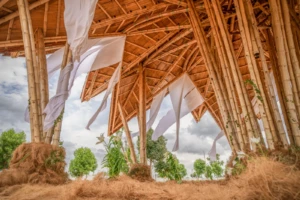
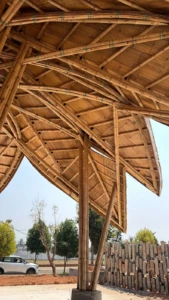
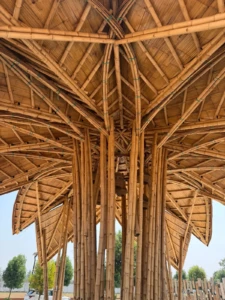
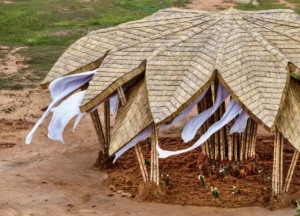
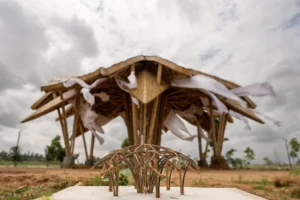
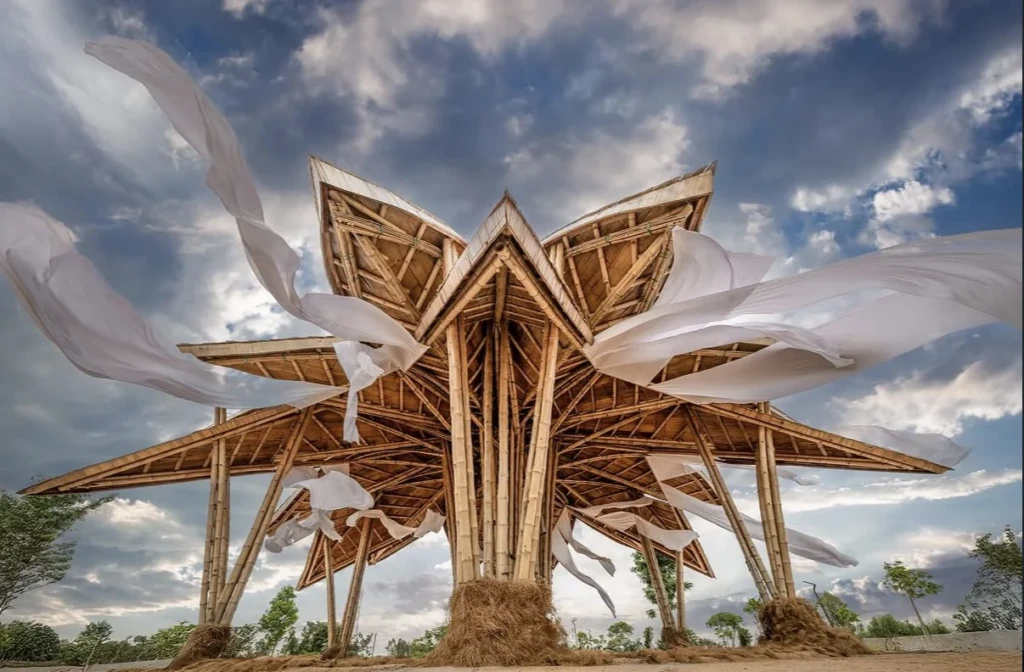
Inspired by the geometry of a lotus in bloom, the pavilion rises from a dense central bamboo core into layered petal-like roof forms that radiate outward. The structure remains open from all sides, encouraging movement, gathering, and continuous visual connection with the surrounding landscape.
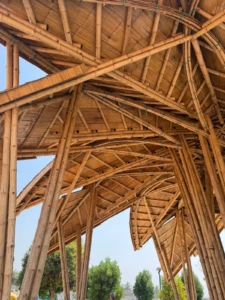
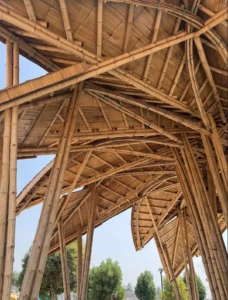
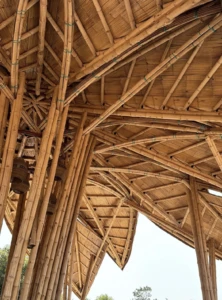
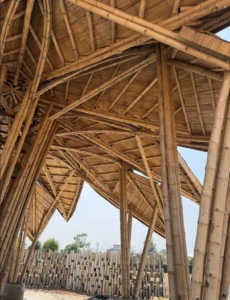
Given the site’s high wind exposure, the pavilion was developed through a porous and aerodynamic structural configuration that allows wind to move through the form rather than resist against it. A central cluster of vertical bamboo members anchors the canopy, while radiating structural elements distribute loads efficiently across the expansive roof geometry.
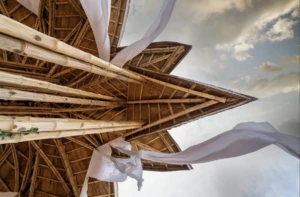
The roof was developed as a layered bamboo assembly comprising primary structural members, bamboo split purlins, and overlapping flattened bamboo surfaces that create a continuous textured outer skin. Rather than concealing the structural system, the pavilion celebrates it-revealing the precision, craftsmanship, and coordination required to execute such geometrically complex forms.
More than a recreational shelter, the Lotus Pavilion demonstrates bamboo’s ability to negotiate permanence, structural performance, and sculptural architectural expression within contemporary public space.
LOTUS PAVILION
LOTUS PAVILION
Recreational Pavilion | Sarjapura, Bangalore
A sculptural bamboo pavilion exploring the intersection of structural precision, material craftsmanship, and organic architectural form.
Client: Tatvam
Development: Azalea
Dimensions: Height: 23 feet 6 inches
Diameter: 48 feet 10 inches
Duration of construction: 6 Months
Key Highlights
• Flower-inspired geometry developed into a fully resolved three-dimensional bamboo structure.
• 24-foot-high central canopy tapering outward into layered petal-like roof planes.
• Wind-responsive structural system designed for Bangalore’s exposed site conditions.
• Radial bamboo framework balancing structural stability with visual lightness.
• Craft-led bamboo detailing expressed through exposed joinery and layered roof construction.
• Open multi-directional pavilion designed as a communal recreational gathering space.
Project Narrative
Located within Tatvam’s Azalea development, the Lotus Pavilion was conceived as a recreational landmark integrated into the larger pool and leisure landscape. Designed and executed by Ekarth Studio as a turnkey design-and-build project, the pavilion explores bamboo’s potential as both a structural system and an expressive architectural language.
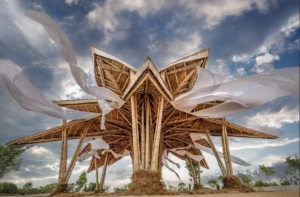
Inspired by the geometry of a lotus in bloom, the pavilion rises from a dense central bamboo core into layered petal-like roof forms that radiate outward. The structure remains open from all sides, encouraging movement, gathering, and continuous visual connection with the surrounding landscape.
Given the site’s high wind exposure, the pavilion was developed through a porous and aerodynamic structural configuration that allows wind to move through the form rather than resist against it. A central cluster of vertical bamboo members anchors the canopy, while radiating structural elements distribute loads efficiently across the expansive roof geometry.
The roof was developed as a layered bamboo assembly comprising primary structural members, bamboo split purlins, and overlapping flattened bamboo surfaces that create a continuous textured outer skin. Rather than concealing the structural system, the pavilion celebrates it-revealing the precision, craftsmanship, and coordination required to execute such geometrically complex forms.
More than a recreational shelter, the Lotus Pavilion demonstrates bamboo’s ability to negotiate permanence, structural performance, and sculptural architectural expression within contemporary public space.