
Studio page
“A shared exploration of bamboo, ecology, and engineering gradually shaped the foundation of Ekarth Studio.”
Ekarth Studio began through a shared interest in bamboo as a material capable of addressing both ecological and structural concerns within contemporary architecture.This exploration led both co- founders independently to Auroville Bamboo Center. Over time, these parallel explorations evolved into a shared design philosophy—one that brings together spatial sensitivity, engineering precision, craftsmanship, and environmental responsibility.
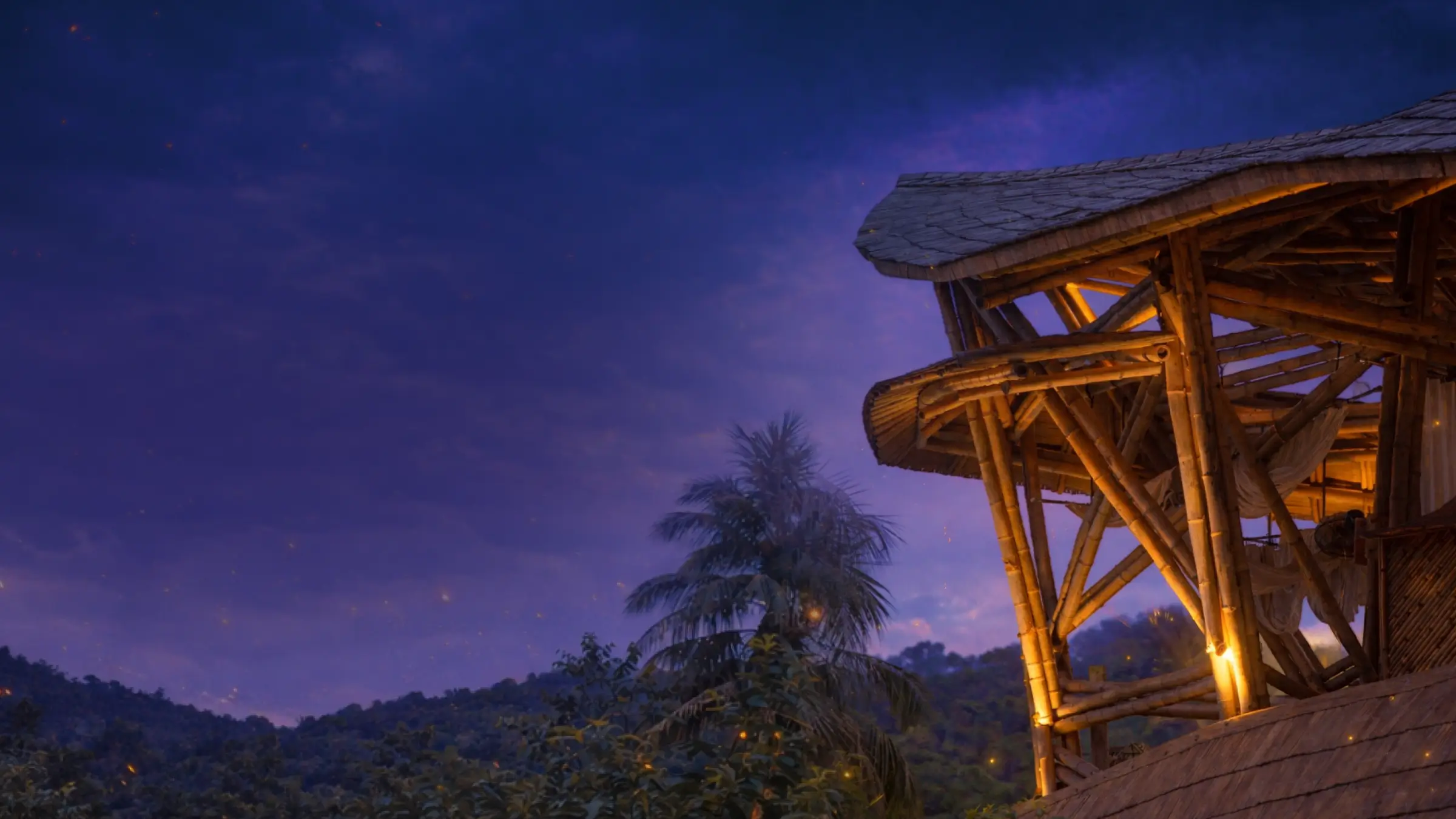
This led to the studio’s first built project: The Firefly – a two-storey bamboo residence in Assam that explored the architectural and structural potential of bamboo within a contemporary context.
Initially conceived as a design experiment, the project gradually revealed the absence of a reliable ecosystem for natural material construction in India. It became evident that building meaningfully with bamboo required far more than design intent
alone. The entire process – from sourcing and harvesting to treatment, transportation, construction, detailing, and finishing – needed to be approached with the same level of sensitivity and precision as the architecture itself. In response, Ekarth slowly evolved into a fully integrated design-build practice.
The intention was never simply to build with bamboo, but to create a more conscious way of building altogether – one that considered not only the final structure, but also the land it stood on, the resources it consumed, the craftsmanship involved, and the larger ecological impact of construction.
The Firefly went on to receive significant recognition, opening conversations around bamboo as a viable material for contemporary construction in India. More importantly, it laid the foundation for Ekarth Studio’s larger direction – integrating
ecological sensitivity, engineering innovation, craftsmanship, and emotionally grounded design into contemporary architecture.
Since then, the studio has continued to evolve through an ongoing exploration of how architecture can become more conscious, immersive, and deeply connected to both people and place.
For the studio, design and structure are inseparable—together they shape atmosphere, spatial quality, and the human experience.
Through its integrated design-build approach, Ekarth seeks to create buildings where technical rigor, material intelligence, ecological sensitivity, and architectural expression exist in balance—resulting in spaces that feel both structurally honest and deeply connected to their surroundings.
| Architecture | Engineering |
|---|---|
| Human experience | Structural logic |
| Craft | Precision |
| Atmosphere | Performance |
| Cultural sensitivity | Technical feasibility |
What Sets EKARTH Apart
Contextual Design
Each project grows organically from its surroundings.
Craft-Led Approach
Celebrating material honesty and skilled handwork.
Experiential Architecture
Spaces that evoke emotion, memory, and harmony.

