HERITAGE VILLAS AT REIS MAGOS
Curated Heritage Residences | Goa, India
A heritage revitalization project reinterpreting Goa’s architectural legacy through adaptive reuse, contextual living, and contemporary refinement.
Client: Ramindri Group
Residences: 4 Curated Villas
Key Highlights
• Adaptive reuse of an existing heritage structure instead of demolition and reconstruction.
• Contemporary reinterpretation of Goa’s colonial architectural language.
• Four curated villas designed with private pools, terraces, balconies, and landscaped edges.
• Preservation of regional identity through materiality, façade proportions, and detailing.
• Integration of modern luxury within historically rooted architectural frameworks.
• Focus on contextual living, climate responsiveness, and timeless spatial quality.
Project Narrative
Located in the culturally significant precinct of Reis Magos, Goa, the project explores the revitalization of an existing architectural asset through a process of adaptive reuse, restoration, and contemporary reinterpretation. Rather than replacing the structure through generic redevelopment, the project was conceived around the idea of preserving character, memory, and regional identity while transforming the property into a refined contemporary living environment.
For Ekarth Studio, the intent behind undertaking the project was rooted in the belief that heritage structures possess an irreplaceable spatial and cultural value that extends beyond aesthetics. In rapidly transforming urban contexts where demolition often replaces preservation, the project proposes an alternative architectural approach-one that views restoration not as nostalgia, but as a future-facing act of cultural continuity and sustainable development.
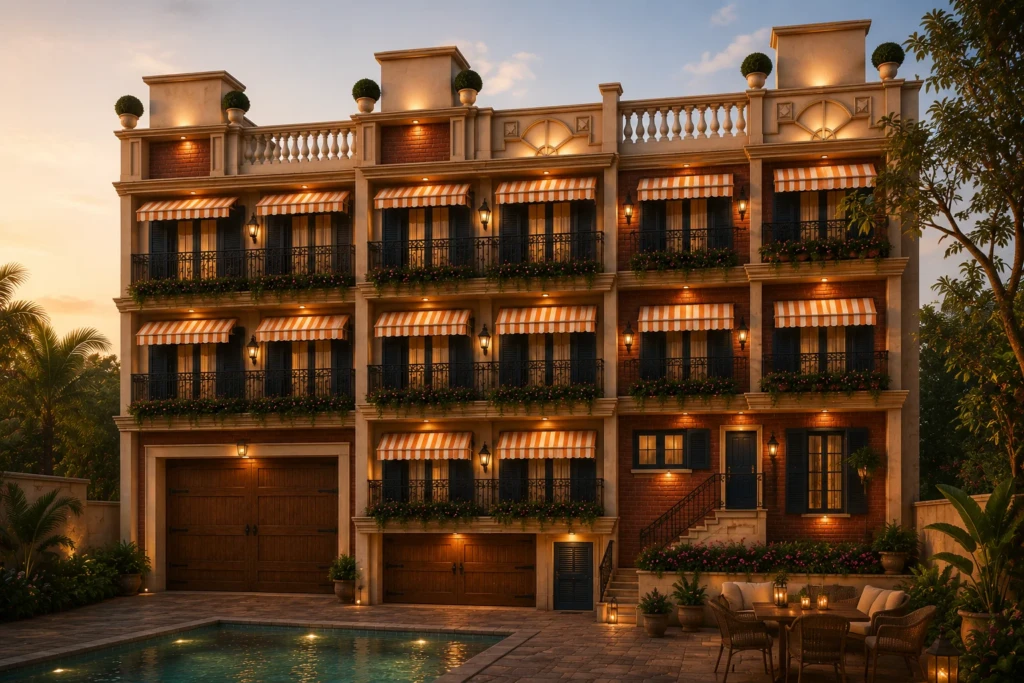
Architecturally, the intervention draws from the layered language of Goan colonial architecture while carefully adapting it to contemporary modes of living. Existing proportions, façade rhythms, balconies, terraces, railings, material palettes, and ornamental details are retained and reinterpreted to preserve the emotional familiarity of the original structure while enhancing functionality, openness, and spatial comfort.
The redevelopment comprises four curated villas designed as private residential experiences integrated within a shared heritage framework. Private pools, rooftop terraces, balconies, landscaped peripheries, and naturally ventilated living spaces create a balance between intimacy, leisure, and contextual living. A key aspect of the project lies in the idea of revival over replacement. By restoring and adapting the existing built fabric rather than erasing it, the project significantly reduces material waste while preserving the cultural memory embedded within the structure. The intervention demonstrates how heritage architecture can evolve meaningfully without losing its identity or authenticity.
HERITAGE VILLAS AT REIS MAGOS
HERITAGE VILLAS AT REIS MAGOS
Curated Heritage Residences | Goa, India
A heritage revitalization project reinterpreting Goa’s architectural legacy through adaptive reuse, contextual living, and contemporary refinement.
Client: Ramindri Group
Residences: 4 Curated Villas
Key Highlights
• Adaptive reuse of an existing heritage structure instead of demolition and reconstruction.
• Contemporary reinterpretation of Goa’s colonial architectural language.
• Four curated villas designed with private pools, terraces, balconies, and landscaped edges.
• Preservation of regional identity through materiality, façade proportions, and detailing.
• Integration of modern luxury within historically rooted architectural frameworks.
• Focus on contextual living, climate responsiveness, and timeless spatial quality.
Project Narrative
Located in the culturally significant precinct of Reis Magos, Goa, the project explores the revitalization of an existing architectural asset through a process of adaptive reuse, restoration, and contemporary reinterpretation. Rather than replacing the structure through generic redevelopment, the project was conceived around the idea of preserving character, memory, and regional identity while transforming the property into a refined contemporary living environment.
For Ekarth Studio, the intent behind undertaking the project was rooted in the belief that heritage structures possess an irreplaceable spatial and cultural value that extends beyond aesthetics. In rapidly transforming urban contexts where demolition often replaces preservation, the project proposes an alternative architectural approach-one that views restoration not as nostalgia, but as a future-facing act of cultural continuity and sustainable development.
Architecturally, the intervention draws from the layered language of Goan colonial architecture while carefully adapting it to contemporary modes of living. Existing proportions, façade rhythms, balconies, terraces, railings, material palettes, and ornamental details are retained and reinterpreted to preserve the emotional familiarity of the original structure while enhancing functionality, openness, and spatial comfort.
The redevelopment comprises four curated villas designed as private residential experiences integrated within a shared heritage framework. Private pools, rooftop terraces, balconies, landscaped peripheries, and naturally ventilated living spaces create a balance between intimacy, leisure, and contextual living. A key aspect of the project lies in the idea of revival over replacement. By restoring and adapting the existing built fabric rather than erasing it, the project significantly reduces material waste while preserving the cultural memory embedded within the structure. The intervention demonstrates how heritage architecture can evolve meaningfully without losing its identity or authenticity.