THE SIANG
Riverfront Hospitality Development
A riverfront hospitality development exploring the integration of terrain-responsive planning, expressive structural systems, and biomorphic bamboo architecture.
Site Area: 4 acres
Phase 1 Built-up Area: 8.860 sq ft
Number of Keys (Phase 1): 8
Site Context: Riverfront | Steep Sloping Terrain
Material Language: Bamboo + Natural Material Palette
KEY HIGHLIGHTS
• Luxury hospitality development positioned along the banks of the Siang River
• Master planning developed through extensive view, privacy, orientation, and terrain studies
• Site negotiated across nearly 50 meters of natural slope variation
• Multiple villa and cottage typologies responding to distinct microclimatic and topographical conditions
• Sculptural biomorphic roof systems inspired by organic natural geometries and aerodynamic forms
• Elevated structural systems minimizing site intervention while negotiating uneven terrain
• Architecture designed to respond to high rainfall, moisture exposure, and river-edge climatic conditions
• Demonstrates Ekarth Studio’s capability in large-scale hospitality planning and terrain-responsive development
PROJECT NARRATIVE
Located on the banks of the Siang River in Pasighat, Arunachal Pradesh, The Siang explores a highly site-responsive approach to hospitality architecture shaped by terrain, climate, riverfront conditions, and structural adaptability. Conceived as part of a larger resort development, the project investigates how immersive hospitality environments can emerge directly from the logic of landscape rather than conventional planning models.
The site presented significant architectural and technical challenges. Defined by dramatic natural contours, dense vegetation, heavy rainfall exposure, high moisture conditions, and nearly fifty meters of slope variation, the project
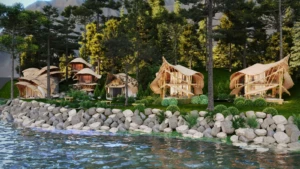
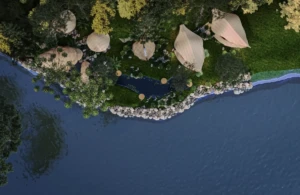
demanded extensive studies around grading, accessibility, drainage, structural stability, orientation, and visual privacy. Every built form was strategically positioned to minimize intervention within the terrain while maximizing panoramic views toward the Siang River and surrounding landscape.
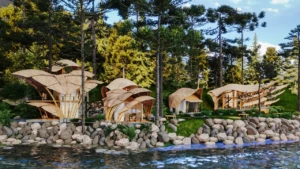
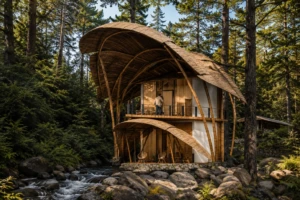
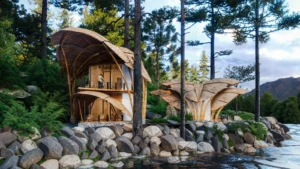
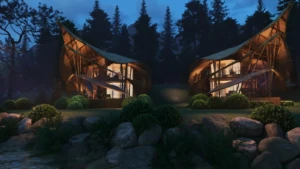
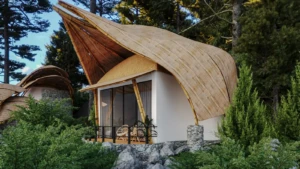
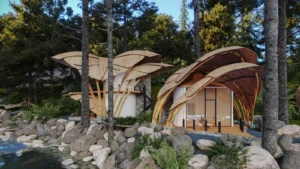
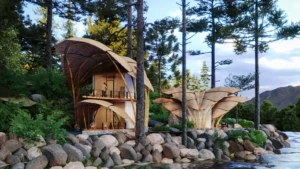
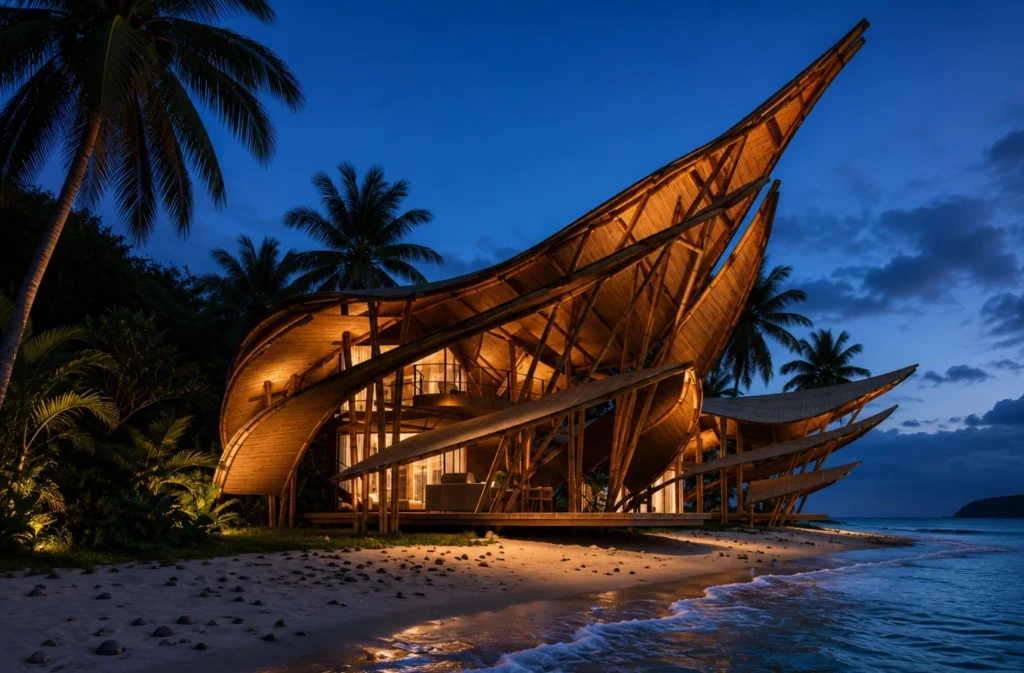
Architecturally, the development is defined through a series of biomorphic roof geometries inspired by leaves, wings, river currents, and naturally occurring organic formations. Sweeping canopies, lifted edges, and layered roof profiles create architecture that feels lightweight, aerodynamic, and deeply responsive to the environmental forces acting upon the site.
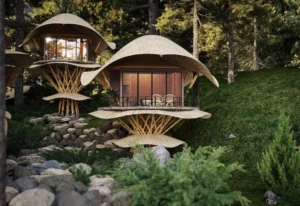
The structural systems were developed not only as visual expressions, but as technical responses to uneven terrain and challenging climatic conditions. Elevated foundations, branching support systems, cantilevered decks, and lightweight bamboo frameworks allow the architecture to negotiate difficult ground conditions while reducing excavation and disturbance to the natural landscape. Large overhangs and layered roof assemblies further respond to intense rainfall and solar exposure while creating shaded transitional spaces throughout the development.
Beyond its technical response, the project was envisioned as an immersive hospitality experience deeply connected to the drama of the Siang River landscape. Every villa and cottage was designed to frame uninterrupted views while maintaining a sense of isolation, stillness, and intimacy with nature. Elevated decks, expansive openings, and semi-open spaces allow visitors to remain continuously connected to shifting light conditions, rainfall, river movement, vegetation, and distant mountain views-transforming the experience into one of inhabiting the landscape rather than simply observing it.
Multiple residential typologies were developed across the site, each responding differently to elevation, proximity to water, surrounding vegetation, and experiential conditions. Rather than repeating identical units, the project creates a curated hospitality environment where every dwelling establishes its own spatial and visual relationship with the landscape.
THE SIANG
THE SIANG
Riverfront Hospitality Development
A riverfront hospitality development exploring the integration of terrain-responsive planning, expressive structural systems, and biomorphic bamboo architecture.
Site Area: 4 acres
Phase 1 Built-up Area: 8.860 sq ft
Number of Keys (Phase 1): 8
Site Context: Riverfront | Steep Sloping Terrain
Material Language: Bamboo + Natural Material Palette
KEY HIGHLIGHTS
• Luxury hospitality development positioned along the banks of the Siang River
• Master planning developed through extensive view, privacy, orientation, and terrain studies
• Site negotiated across nearly 50 meters of natural slope variation
• Multiple villa and cottage typologies responding to distinct microclimatic and topographical conditions
• Sculptural biomorphic roof systems inspired by organic natural geometries and aerodynamic forms
• Elevated structural systems minimizing site intervention while negotiating uneven terrain
• Architecture designed to respond to high rainfall, moisture exposure, and river-edge climatic conditions
• Demonstrates Ekarth Studio’s capability in large-scale hospitality planning and terrain-responsive development
PROJECT NARRATIVE
Located on the banks of the Siang River in Pasighat, Arunachal Pradesh, The Siang explores a highly site-responsive approach to hospitality architecture shaped by terrain, climate, riverfront conditions, and structural adaptability. Conceived as part of a larger resort development, the project investigates how immersive hospitality environments can emerge directly from the logic of landscape rather than conventional planning models.
The site presented significant architectural and technical challenges. Defined by dramatic natural contours, dense vegetation, heavy rainfall exposure, high moisture conditions, and nearly fifty meters of slope variation, the project
demanded extensive studies around grading, accessibility, drainage, structural stability, orientation, and visual privacy. Every built form was strategically positioned to minimize intervention within the terrain while maximizing panoramic views toward the Siang River and surrounding landscape.
Architecturally, the development is defined through a series of biomorphic roof geometries inspired by leaves, wings, river currents, and naturally occurring organic formations. Sweeping canopies, lifted edges, and layered roof profiles create architecture that feels lightweight, aerodynamic, and deeply responsive to the environmental forces acting upon the site.
The structural systems were developed not only as visual expressions, but as technical responses to uneven terrain and challenging climatic conditions. Elevated foundations, branching support systems, cantilevered decks, and lightweight bamboo frameworks allow the architecture to negotiate difficult ground conditions while reducing excavation and disturbance to the natural landscape. Large overhangs and layered roof assemblies further respond to intense rainfall and solar exposure while creating shaded transitional spaces throughout the development.
Beyond its technical response, the project was envisioned as an immersive hospitality experience deeply connected to the drama of the Siang River landscape. Every villa and cottage was designed to frame uninterrupted views while maintaining a sense of isolation, stillness, and intimacy with nature. Elevated decks, expansive openings, and semi-open spaces allow visitors to remain continuously connected to shifting light conditions, rainfall, river movement, vegetation, and distant mountain views-transforming the experience into one of inhabiting the landscape rather than simply observing it.
Multiple residential typologies were developed across the site, each responding differently to elevation, proximity to water, surrounding vegetation, and experiential conditions. Rather than repeating identical units, the project creates a curated hospitality environment where every dwelling establishes its own spatial and visual relationship with the landscape.